Auditory contexts with different temporal structures modulate decision latency in visual cue-based decision-making
DongJun Kim1, Do Eun Kim1, Jong Chan Jeon1, and So Young Kim1,2,3
1Department of Anatomy and Cell Biology, Seoul National University College of Medicine, Seoul, Republic of Korea
2Sensory Organ Research Institute, Seoul National University Medical Research Center, Seoul, Republic of Korea
3Sensory Organ Research Institute, Seoul National University College of Medicine, Seoul, Republic of Korea
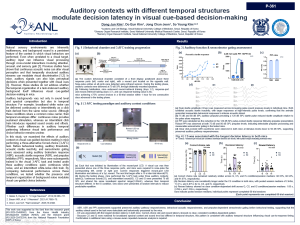
Auditory context contributes to environmental perception, with temporal and spectral features contributing to sensory processing. In this study, we examined whether the temporal structure of auditory context affects visually guided decision-making using a mouse three-alternative forced-choice (3-AFC) task. Mice were trained to select one of three response ports according to a visual cue. After stable performance, behavioral responses were tested in three auditory contexts: quiet (Q), continuous sound (CS), and intermittent sound (IS). The auditory stimuli were matched for frequency range (2-20kHz) and intensity (70 dB), while temporal structure was manipulated as continuous (CS) or random inter-trial interval presentation (IS) to minimize spectral and intensity differences.
Task performance was evaluated within the first 60 trials using correct choice rate (CCR), decision latency (DL; visual cue to nose poke, decision phase), and reward latency (RL; nose poke to lick, reward phase). CCR remained high across auditory contexts, with median hit rates of 88.33%, 88.33%, and 90.83% in the Q, CS, and IS conditions, respectively. In contrast, DL differed significantly across conditions (one-way ANOVA, F (2,35) = 5.126, p = 0.011). Median DLs were 2.64 s, 8.43 s, and 4.43 s in the Q, CS, and IS conditions, respectively. Tukey post hoc analysis showed that DL was significantly increased in CS compared with Q (p = 0.010). Median RLs were 1.71 s, 2.29 s, and 1.43 s in the Q, CS, and IS conditions, with no significant differences among conditions. These findings suggest that auditory context influences decision timing during visual cue-based behavior. In particular, CS increased decision latency without affecting choice accuracy or reward retrieval.
Keywords: Three-alternative forced-choice task, auditory context, white noise, click train, visual decision-making, Behavioral task