Active noise cancellation alters auditory cortex activation and behavioral responses independent of sound pressure
Nahae Park1, Jong Chan Jeon1, Jae-Young Joo3, Obin Kwon2,3 and So Young Kim1,2
1Department of Anatomy and Cell Biology, Seoul National University College of Medicine, Seoul, Republic of Korea
2Sensory Organ Research Institute, Seoul National University Medical Research Center, Seoul, Republic of Korea
3Department of Biomedical Science, Seoul National University College of Medicine, Seoul, Republic of Korea
1. Acute active noise cancelling (ANC) exposure altered behavioral responses in rats.
2. Acute ANC exposure modulated c-Fos expression in auditory brain regions.
3. Noise attenuation by ANC may influence auditory-related neural processing.
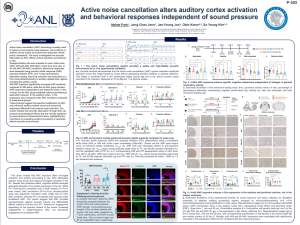
Background: Active noise cancellation (ANC) technology is widely used to reduce environmental noise exposure, yet its effects on auditory neural activity and behavioral responses remain poorly understood. This study investigated how acoustic attenuation by ANC affects cortical activation and behavior in rats.
Methods: Sprague-Dawley rats were exposed to quiet, white noise (WN), WN with ANC (WN-ANC), 4 kHz pure tone (4k), or 4k with ANC (4k-ANC) conditions. Behavioral responses were assessed using acoustic startle response (ASR), prepulse inhibition (PPI), and Y-maze spontaneous alternation testing. Neuronal activation was evaluated by c-Fos immunohistochemistry in auditory-related brain regions including the auditory cortex.
Results: WN-ANC exposure significantly increased ASR amplitude compared to WN alone, while the 4k-ANC group showed ASR responses comparable to pre-exposure levels. In the Y-maze, the 4k-ANC group exhibited reduced spontaneous alternation behavior. In the auditory cortex, c-Fos expression was increased under ANC conditions compared to noise-alone groups.
Conclusion: These findings suggest that spectral modification by ANC may influence auditory-related neural and behavioral responses differently from passive noise reduction. The results indicate that acoustic attenuation through ANC can produce neurobiological effects that are not fully explained by sound pressure measurements alone, highlighting the importance of evaluating auditory processing in spectrally altered acoustic environments.