Early Postnatal Organotypic Cochlear Explant Culture :
an Ex Vivo Platform for Auditory Neural Characterization
Nuri Jin1, Do Eun Kim1, Nahae Park1, Bohyeon Park1, Dong-jun Kim1, Jong Chan Jeon1, So Young Kim1,2
1Anatomy and Cell Biology, Seoul National University, Seoul, Republic of Korea
2Sensory Organ Research Institude , Seoul National University Medical Research Center, Seoul, Republic of Korea
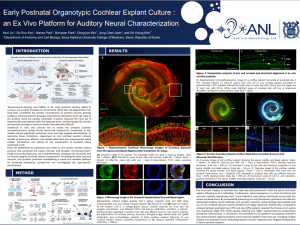
Cochlear synaptopathy, a key contributor to sensorineural hearing loss, involves degeneration of the inner hair cell (IHC)-spiral ganglion neurons (SGNs) ribbon synapse, SGNs and their neurite projections. Direct observation and molecular characterization of the IHC-SGN synaptic interface and SGN remain technically challenging due to the anatomical complexity and limited accessibility of the inner ear. Furthermore, conventional cell line models fail to preserve the structural organization and cellular interactions inherent to the cochlea. Organotypic cochlear explant culture has thus emerged as a valuable ex vivo platform for studying auditory neural tissue while maintaining native tissue architecture.
We established early postnatal organotypic cochlear explant cultures to evaluate SGN morphology and organization of the IHC-SGN synaptic region. Cochleae from postnatal day 2 (P2) and postnatal day 4 (P4) mice were cultured for 3 and 2 days in vitro (DIV), respectively. Immunostaining with TUJ1 and Myosin7a assessed overall neuronal and IHC morphology. P2 explants exhibited well-preserved SGN neurite architecture and IHC organization. In P4 explants, SGN neurites remained structurally maintained. The punctate localization of Cav1.3 adjacent to presynaptic sites and calretinin expression in IHC-SGN synaptic region was consistently observed at both timepoints, supporting the applicability of this model for molecular characterization of the IHC–SGN synaptic interface.
These findings demonstrate that early postnatal organotypic cochlear explant culture preserves the IHC-SGN synaptic architecture and supports SGN characterization. This model offers a tractable ex vivo platform for investigating neuronal and synaptic mechanisms and may facilitate screening of therapeutic strategies targeting cochlear neural integrity in hearing loss
Keywords: Cochlear synaptopathy, Peripheral auditory neurons, Ex vivo neural modeling, Spiral ganglion neuron, Postnatal neural development