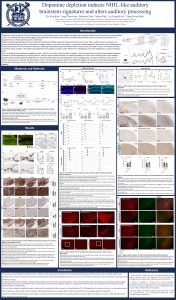
Dopamine depletion induces NIHL-like auditory brainstem signatures and alters auditory processing
Do Eun Kim1, Jong Chan Jeon1, Bohyeon Park1, Nahae Park1, So Young Kim1,2, Jung Hwan Shin3
1Department of Anatomy and Cell Biology, Seoul National University College of Medicine, Seoul, Republic of Korea
2Sensory Organ Research Institute, Seoul National University Medical Research Center, Seoul, Republic of Korea
3Department of Neurology, Seoul National University Hospital, Seoul, Republic of Korea
Dopamine is best known for its role in motor control and motivation, but it is also present throughout the auditory system, from the cochlea to central auditory circuits. This widespread distribution suggests that dopamine may influence how sound is encoded and transmitted, yet the functional consequences of dopamine loss on hearing remain poorly understood.
Auditory processing depends on precise peripheral encoding and tightly regulated timing within brainstem circuits. When auditory input is reduced, as in noise-induced hearing loss (NIHL), characteristic changes emerge in the auditory brainstem. In particular, delayed peripheral signaling is often accompanied by relative preservation of early brainstem responses, reflecting compensatory hyperexcitability within nuclei such as the medial nucleus of the trapezoid body and lateral olivary complex. These NIHL-associated brainstem patterns provide a useful reference for identifying circuit-level adaptations to reduced auditory input.
Here, we asked whether dopamine depletion alone is sufficient to produce similar auditory changes. Using a mouse model of central dopaminergic depletion induced by 6-hydroxydopamine (6-OHDA) injection into the medial forebrain bundle, we examined auditory function across multiple levels of the auditory pathway. We found that dopamine-depleted mice show elevated auditory thresholds together with prolonged wave I and wave V latencies, while wave II latency is preserved or reduced. This dissociation mirrors the functional signature observed in NIHL and suggests the emergence of a hyperexcitable state in early auditory brainstem circuits. Together, these findings indicate that dopamine plays a critical role in maintaining auditory sensitivity and brainstem circuit stability.